The Age Gap Couple Playbook: Hollywood Keeps Running the Same Script and We Keep Reading Every Page

It always starts the same way. The photos surface — paparazzi shots that feel just a little too clean, or a social media post that's been clearly thought about — and within approximately four hours, the internet has done the math. The age difference is calculated, screenshotted, and posted. The discourse begins. And somewhere in a publicist's office, someone nods and says right on schedule.
Celebrity couples with significant age gaps have become one of entertainment's most reliable content engines, not because the relationships themselves are inherently newsworthy, but because the PR rollout around them has been refined to such a degree that it now functions almost like a franchise. The beats are predictable. The talking points are familiar. The fan response splits along lines so consistent you could set a watch by them. And yet, somehow, every time a new couple enters the cycle, the whole thing feels fresh enough to dominate the conversation for weeks.
So let's talk about the playbook.
Step One: The Controlled Debut
Age-gap celebrity couples almost never just appear. The debut is managed with a precision that would be impressive in a military context. The first public sighting is almost always ambiguous enough to generate speculation without confirmation — a dinner that could be professional, a concert attendance that could be coincidental, a vacation photo where the framing does a lot of work. This ambiguity phase is important because it lets the audience do the first wave of coverage for free. The speculation is the press cycle.
The confirmation, when it comes, tends to arrive via one of two routes: a source close to the couple leaking to a major outlet (People, E! News, Us Weekly — the holy trinity of relationship confirmation), or a social media post that's been clearly deliberated over for longer than most people spend on major life decisions. The caption is warm but not excessive. The comments are turned on. The timing — a Friday afternoon, a Sunday morning, never a Tuesday when nobody's paying attention — is chosen carefully.
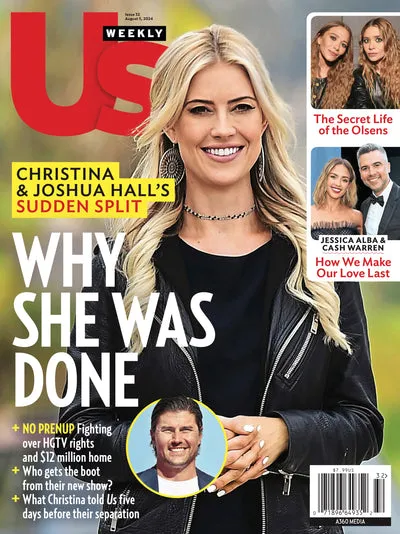 Photo: Us Weekly, via magazineshop.us
What's notably absent from the debut is any direct acknowledgment of the age difference. That comes later, in a separate, controlled environment.
Step Two: The Interview That Addresses the Thing Everyone's Already Talking About
This is perhaps the most choreographed moment in the entire cycle. Roughly four to eight weeks after the relationship goes public — long enough for the discourse to build, not long enough for it to peak and fade — one or both members of the couple gives an interview in which the age gap is addressed. The venue is almost always a profile piece in a publication that skews sympathetic: a fashion magazine, a culture-focused outlet, somewhere the framing will be warm.
The quotes follow a remarkably consistent template. There is usually a variation of age is just a number. There is almost always something about finding someone who truly understands you or being at the same place emotionally. The older partner tends to get a line about feeling young again or finding new perspective. The younger partner gets a line about maturity and knowing what they want. Both parties describe the relationship as easy or natural with a frequency that starts to feel statistically significant.
What the interview almost never includes: any real engagement with the structural dynamics that make age-gap relationships genuinely complicated — the power differentials, the life-stage mismatches, the ways that significant age differences in celebrity relationships often intersect with career status and financial imbalance. These are not questions that get asked in the sympathetic profile. They get asked, instead, by the internet.
Step Three: The Fan Base Split
This part of the cycle arrives with the reliability of a weather pattern. The age-gap couple announcement generates two distinct and vocal audience factions, and their emergence is so consistent that you can almost predict the exact arguments before they're made.
Faction one: the supporters, who tend to emphasize autonomy, the irrelevance of age between consenting adults, and the hypocrisy of scrutinizing this particular couple when other relationships with more 'acceptable' dynamics receive no such attention. These are not unreasonable points.
Faction two: the skeptics, who raise questions about power dynamics, the pattern of which direction the age gap tends to run (older man, younger woman remains statistically dominant in high-profile cases, a fact that attracts feminist critique), and whether the PR framing is doing work to obscure rather than illuminate the actual dynamics at play. These are also not unreasonable points.
Both factions are loud. Both generate engagement. Both, whether they intend to or not, function as free marketing for the couple's ongoing public narrative. The discourse is the coverage. The coverage is the career bump.
The Career Bump Is Real and Rarely Accidental
Here's the part of the age-gap celebrity relationship cycle that doesn't get discussed enough: the timing almost always benefits at least one person's career in a measurable and traceable way.
The pattern most frequently observed is the older partner experiencing a visibility renaissance — interviews they might not have otherwise landed, a renewed social media following, coverage in outlets that had stopped paying attention. The relationship becomes, effectively, a relevance injection. The younger partner, meanwhile, often benefits from association with an established name and the credibility that proximity to a longer career can confer.
None of this means the relationships aren't real. It means that in Hollywood, where personal life and professional strategy have never been cleanly separated, the two things coexist and the PR machine is very good at making sure they coexist profitably.
What the Formula Flattens
The genuinely interesting question underneath all of this isn't whether celebrity age-gap couples are running a PR playbook — they clearly are, and so is every other type of celebrity relationship. The interesting question is what gets lost when a complex human dynamic gets processed through a content template.
Age-gap relationships involve real conversations about power, compatibility, life stage, and long-term alignment that are worth having. The PR playbook, by design, replaces those conversations with a set of reassuring talking points that close down inquiry rather than opening it up. Love is love is a sentence that ends discussions. It doesn't start them.
And the audience, for all its discourse-generating energy, tends to engage with the template rather than the reality — arguing about whether the relationship is acceptable rather than asking what it actually looks like, what it costs, what it produces, and who it serves.
The formula works because it gives everyone exactly what they came for: a debate with no resolution, a couple with a compelling narrative, and enough ambiguity to keep the conversation going until the next announcement drops.
Hollywood didn't invent the age-gap relationship — it just figured out how to make it a content calendar.